TOPICS
Introduction to open sources
Understand the basics of OSINT and the limits of a self-led search.
PRACTICAL RESOURCES
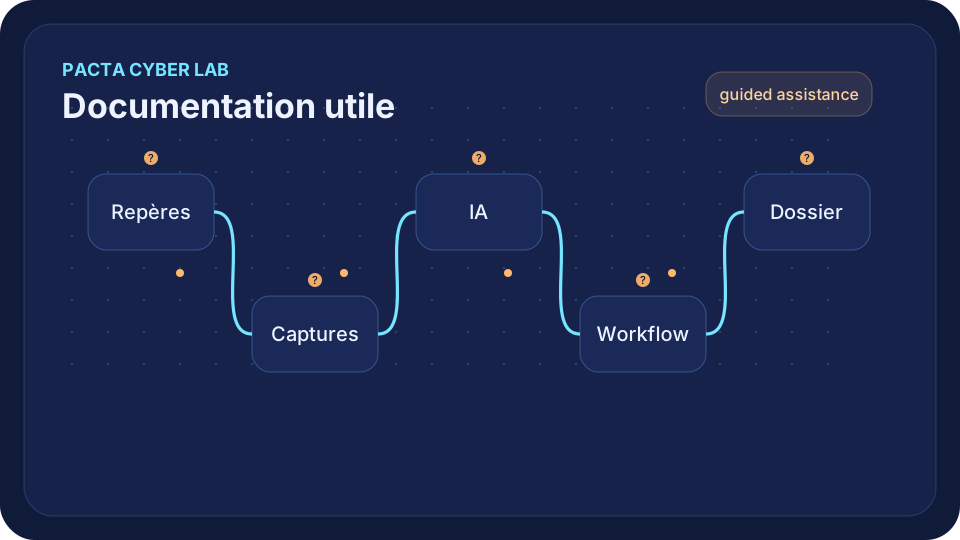
The documentation gathers notes on useful habits, information organisation, stages of open-source research, the role of AI, the value of screenshots, case preparation and the automations that genuinely make work easier.
PRACTICAL RESOURCES
The idea is not to impress with opaque concepts, but to provide concrete footholds. How do you start? What should be kept? What deserves checking? When can an AI assistant help? What should be automated? These questions guide the content.
TOPICS
Understand the basics of OSINT and the limits of a self-led search.
Learn to organise screenshots, profiles, pages, files and links into a coherent set.
Know when AI can guide, summarise, suggest or organise without replacing human judgement.
PRINCIPLES
Use simple and progressive wording, avoiding unnecessary jargon.
Prioritise content that can be directly reused in a real case.
Allow beginners to move forward without being lost from the first lines.
QUICK SEARCH
Enter a keyword to display only the notes matching your need.
Structure the first stages of an open-source search when you are a beginner or facing a confusing situation.
Choose what should be preserved: pages, screenshots, links, files or useful notes.
Know when an assistant can help organise, summarise or explain without replacing analysis.
Identify repetitive tasks that benefit from being delegated to a workflow.
Describe your context: support for a victim, need for a method, tool creation, automated flow, web page, workshop or educational resource.